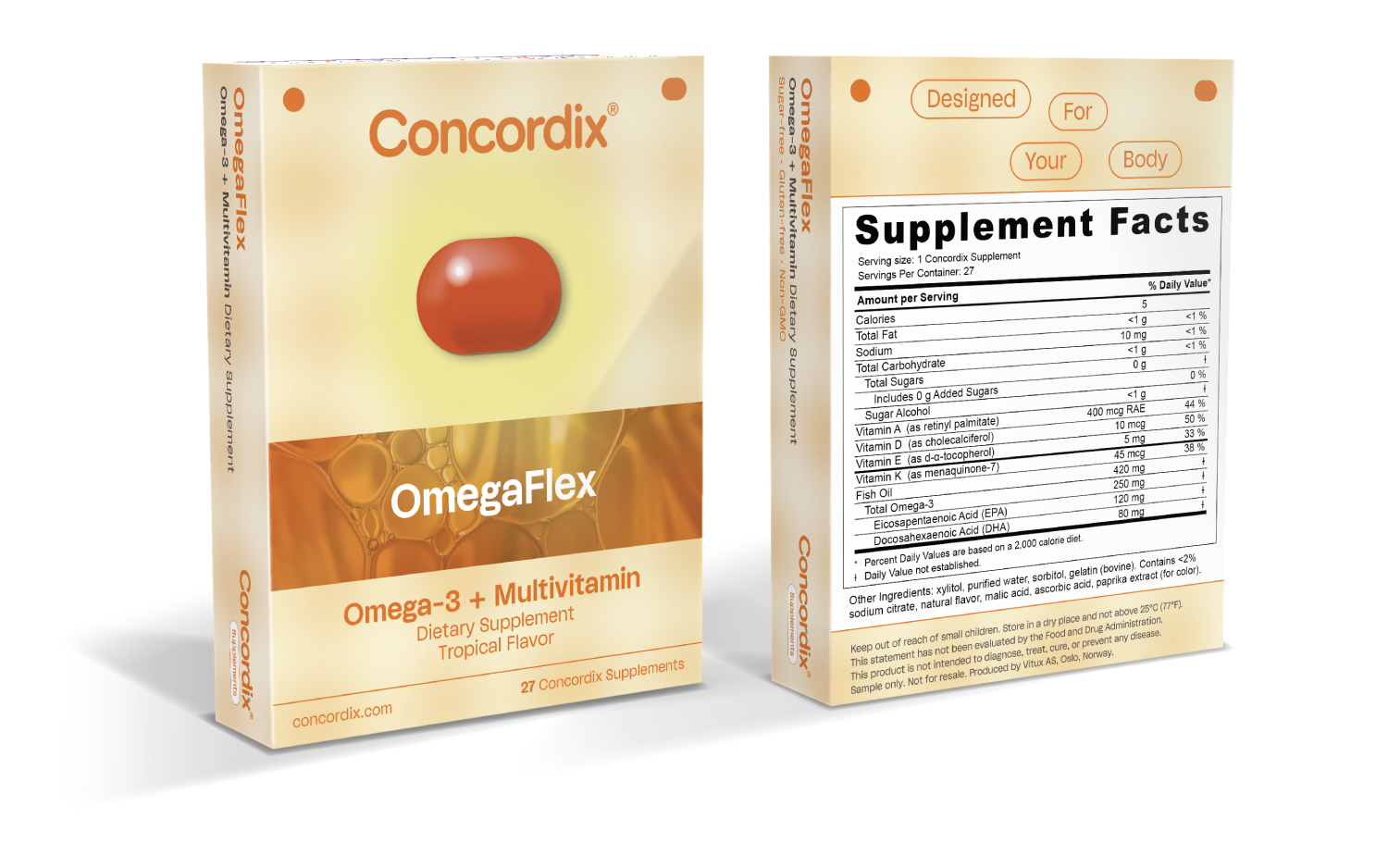
OmegaFlex

Omega-3 + Multivitamin
Tropical Mix Flavor

Bone & Joint Support for Active Living

OmegaFlex is a targeted chewable formulation designed to support bone health, mobility, and overall structural support. Built on the Concordix® platform, it delivers key fat-soluble vitamins in a convenient, great-tasting format for daily use.

Supplement facts

  • Vitamin K2 45 mcg
  • Vitamin E 5 mg
  • Vitamin A 400 mcg-RE
  • Vitamin D3 10 mcg
  • Total Omega-3 250 mg
  • EPA 120 mg
  • DHA 80mg

• Serving Size: 2 Concordix supplement
• Flavor: Tropical
• Color: Red
• Format: round & Oval
• Packaging: Individually sealed in aluminum blister packs; cartons made from recycled material available

Targeted Bone & Joint Support

Vitamin K2 & D3 contribute to the maintenance of normal bones
Vitamin D contributes to normal calcium absorption and utilization
Vitamin A contributes to the normal function of the immune system
Vitamin E contributes to the protection of cells from oxidative stress

Advanced Emulsion-Based Chewable Technology

Concordix® advanced emulsion technology enables the stable delivery of fat-soluble vitamins in a chewable format. These nutrients are dispersed within a structured emulsion matrix, supporting ingredient stability, consistent distribution, and effective taste masking in every dose.

Why Choose Concordix® OmegaFlex

• Bone-focused formula with vitamins K2 and D3 in a single daily chew
• Advanced emulsion system supporting effective delivery of fat-soluble vitamins
• Individually sealed for freshness and reliable potency in every dose
• Pleasant citrus & strawberry flavor with a soft, non-sticky texture
• Sugar-free, with natural colors and flavors
• Manufactured in Norway and Canada in NSF-certified, GMP-compliant facilities

Built for Everyday Strength and Mobility

OmegaFlex brings together essential fat-soluble vitamins in a format designed for consistency and ease of use. With Concordix® advanced emulsion technology supporting stability and reliable delivery, it offers a practical, enjoyable way to maintain daily nutrient intake as part of a long-term approach to bone health.


These statements have not been evaluated by the Food and Drug Administration. This product is not intended to diagnose, treat, cure, or prevent any disease.


Vitamin K

Vitamin K is a group of structurally similar fat-soluble vitamins that are required for the complete synthesis of proteins involved in blood coagulation, and for controlling binding of calcium in the bones and other tissues. Without vitamin K, blood coagulation is seriously impaired, and uncontrolled bleeding occurs. Preliminary clinical research indicates that deficiency of vitamin K may weaken bones, potentially leading to osteoporosis, and may promote calcification of arteries and other soft tissues.

Vitamin K includes two natural vitamers: vitamin K1 and vitamin K2:

Vitamin K1

Vitamin K1, also known as phylloquinone, is made by plants, and is found in highest amounts in green leafy vegetables. It performs the classic functions of vitamin K, including its activity in the production of blood coagulation proteins.
Bacteria in the gut flora can convert K1 into vitamin K2.

Vitamin K2

Vitamin K2 or menaquinone, has a similar mechanism of action as vitamin K1. It is suggested that it plays a key role in bone strength and arterial health.
EFSA has acknowledged the following beneficial effects as a basis for health claim:
• Vitamin K contributes to normal blood clotting
• Vitamin K contributes to the maintenance of normal bones

View all ingredients

Vitamin E

Vitamin E is a generic term covering all tocopherols and tocotrienols which qualitatively exhibit the same biological activity as α−tocopherol. Therefore, vitamin E refers to α-, β-, γ- and δ-tocopherols, plus α-, β-, γ- and δ-tocotrienols.

Antioxidant

Vitamin E is long recognised as the body´s major lipid soluble antioxidant, and thus is fundamental in maintaining the integrity and functionality of the cellular membranes of all cells of the human body. As an antioxidant, vitamin E acts within cell membranes, constructed from unsaturated fatty acids and protects the cell membranes from oxidation. In doing so, the vitamin is oxidised itself and must be ‘recycled’ back to its active form, typically by vitamin C.

Due to its role as an antioxidant, vitamin E may play a key role in the protection against conditions associated with increased oxidative stress, such as cardiovascular disease, diabetes, disorders involving chronic inflammation, cancer, and neurologic disorders.

Other effects

In addition to its antioxidant function, research demonstrated specific roles of vitamin E in signal transduction, gene expression, and regulation of cellular functions, including immune response. There is substantial evidence that vitamin E has a role in the prevention of atherosclerosis by inhibiting low density lipoprotein (LDL) oxidation and anti-inflammatory actions.
EFSA has acknowledged the following beneficial effects as a basis for health claim:
• Vitamin E contributes to the protection of cell constituents from oxidative damage

View all ingredients

Vitamin A

Vitamin A is an essential fat-soluble bioactive, also known as retinol. There are 2 forms of vitamin A available in the diet: preformed and provitamin A. Preformed vitamin A comes from animal sources, with high concentrations in fish oils, eggs and milk. Provitamin A comes from plant sources and is mainly found in the form as carotenoids with the most important one: beta-carotene. The body converts these provitamin carotenoids into vitamin A.

Both preformed vitamin A and provitamin A must be metabolized intracellularly to retinal and retinoic acid, the active forms of vitamin A, to support the vitamin’s important biological function. Vitamin A plays a key role in several bodily functions including:

Vision

Vitamin A is critical for vision as an essential component of rhodopsin, a protein that absorbs light in the retinal receptors. Vitamin A maintains vision because it continuously forms new rhodopsin. Retinoic acid, is a substitute of vitamin A and supports the conjunctival membranes and cornea.

Growth and development

Vitamin A is involved in genetic regulation of cell formation and differentiation and intercellular communication. It is critical during the (neurological) development of the foetus.

Immune system

Vitamin A also supports the immune system and helps to protect against infections and invading antigens.

Skin and mucous membranes

The skin is a mechanical immune barrier, and sufficient concentrations of vitamin A available, maintain skin health.

The European Food Safety Authority (EFSA) has acknowledged the following beneficial effects of preformed vitamin A and provitamin A as a basis for health claims:
• Normal cell differentiation
• Normal function of the immune system
• Maintenance of normal skin and mucous membranes
• Maintenance of normal vision
• Normal metabolism of iron

View all ingredients

Vitamin D

Vitamin D is a fat-soluble vitamin that is naturally present in very few foods such as fish. When the skin is exposed to the sun, the human body is able to synthesize vitamin D from ultraviolet rays. It is involved in many different biological processes including, bone health, immune system and cell division.

Bone health

Vitamin D plays a key role in promoting calcium absorption in the intestine and maintaining adequate blood calcium and phosphate concentrations to enable normal bone mineralization. In this way, vitamin D is important for the proper functioning of the skeleton, and may prevent that bones to become brittle as in osteoporosis.

Other effects

Vitamin D has beneficial effects on muscle function and strength. The vitamin is also involved in cell growth, neuromuscular and immune function and reduction of inflammation. There is accumulating epidemiologic data that a low vitamin D status is inversely associated with disorders such as diabetes, rheumatoid arthritis and multiple sclerosis.
The European Food Safety Authority (EFSA) has acknowledged the following beneficial effects as a basis for health claims:
• Vitamin D contributes to the maintenance of normal muscle function
• Vitamin D contributes to the normal function of the immune system and healthy inflammatory response
• Vitamin D contributes to the normal absorption/utilisation of calcium and phosphorus and maintenance of normal blood calcium concentrations
• Vitamin D contributes to the normal cell division
• Vitamin D contributes to the maintenance of normal bones
• Vitamin D contributes to the maintenance of normal teeth

View all ingredients

Omega-3

Omega-3 fatty acids are essential polyunsaturated fatty acids (PUFA). These PUFAs can not be synthesized by the human body but has many health benefits. The health effects have been extensively documented and probably the most known effect of omega-3 PUFAs is to reduce the risk for cardiovascular diseases. There are also indications that omega-3 PUFAs may lower the risk for dementia and mitigate depression.

The most important omega-3 PUFAs in the human diet are:
1. Alpha-linolenic acid (ALA)
2. Eicosapentaenoic acid (EPA)
3. Docosahexaenoic acid (DHA)

ALA is found in plants, including chia, flaxseed, hemp, and nuts. Plants contain of fibers that are difficult to digest for humans and can reduce absorption of essential bioactives. Some studies indicate that ALA has neuroprotective, anti-inflammatory, and antidepressant properties. The human body contains enzymes that convert ALA into DHA and EPA, however, the conversion rates are often very low with ranges between 1% to 20%.

High concentrations of EPA and DHA are found in fish and shellfish. EPA and DHA in fish oil are easily absorbed by the human body. It is known that these PUFAs have different effects.
For instance, EPA is metabolized to eicosanoids that regulate fundamental physiological processes such as cell division and growth, blood clotting, muscle activity, and the secretion of digestive juices and hormones. Eicosanoids derived from EPA may reduce certain inflammatory processes that can lead to heart attacks and strokes.
DHA is not involved in eicosanoid formation but is highly concentrated in the brain and involved in normal neurological development and functioning. Next to that, DHA is an important part of the retina and plays a role in visual development and normal eye function.

View all ingredients

EPA

Omega-3 fatty acids are essential polyunsaturated fatty acids (PUFA). These PUFAs can not be synthesized by the human body but has many health benefits. The health effects have been extensively documented and probably the most known effect of omega-3 PUFAs is to reduce the risk for cardiovascular diseases. There are also indications that omega-3 PUFAs may lower the risk for dementia and mitigate depression.

The most important omega-3 PUFAs in the human diet are:
1. Alpha-linolenic acid (ALA)
2. Eicosapentaenoic acid (EPA)
3. Docosahexaenoic acid (DHA)

High concentrations of EPA and DHA are found in fish and shellfish. EPA and DHA in fish oil are easily absorbed by the human body. It is known that these PUFAs have different effects.

For instance, EPA is metabolized to eicosanoids that regulate fundamental physiological processes such as cell division and growth, blood clotting, muscle activity, and the secretion of digestive juices and hormones. Eicosanoids derived from EPA may reduce certain inflammatory processes that can lead to heart attacks and strokes.

View all ingredients

DHA

Omega-3 fatty acids are essential polyunsaturated fatty acids (PUFA). These PUFAs can not be synthesized by the human body but has many health benefits. The health effects have been extensively documented and probably the most known effect of omega-3 PUFAs is to reduce the risk for cardiovascular diseases. There are also indications that omega-3 PUFAs may lower the risk for dementia and mitigate depression.

The most important omega-3 PUFAs in the human diet are:
1. Alpha-linolenic acid (ALA)
2. Eicosapentaenoic acid (EPA)
3. Docosahexaenoic acid (DHA)

DHA is not involved in eicosanoid formation but is highly concentrated in the brain and involved in normal neurological development and functioning. Next to that, DHA is an important part of the retina and plays a role in visual development and normal eye function.

View all ingredients