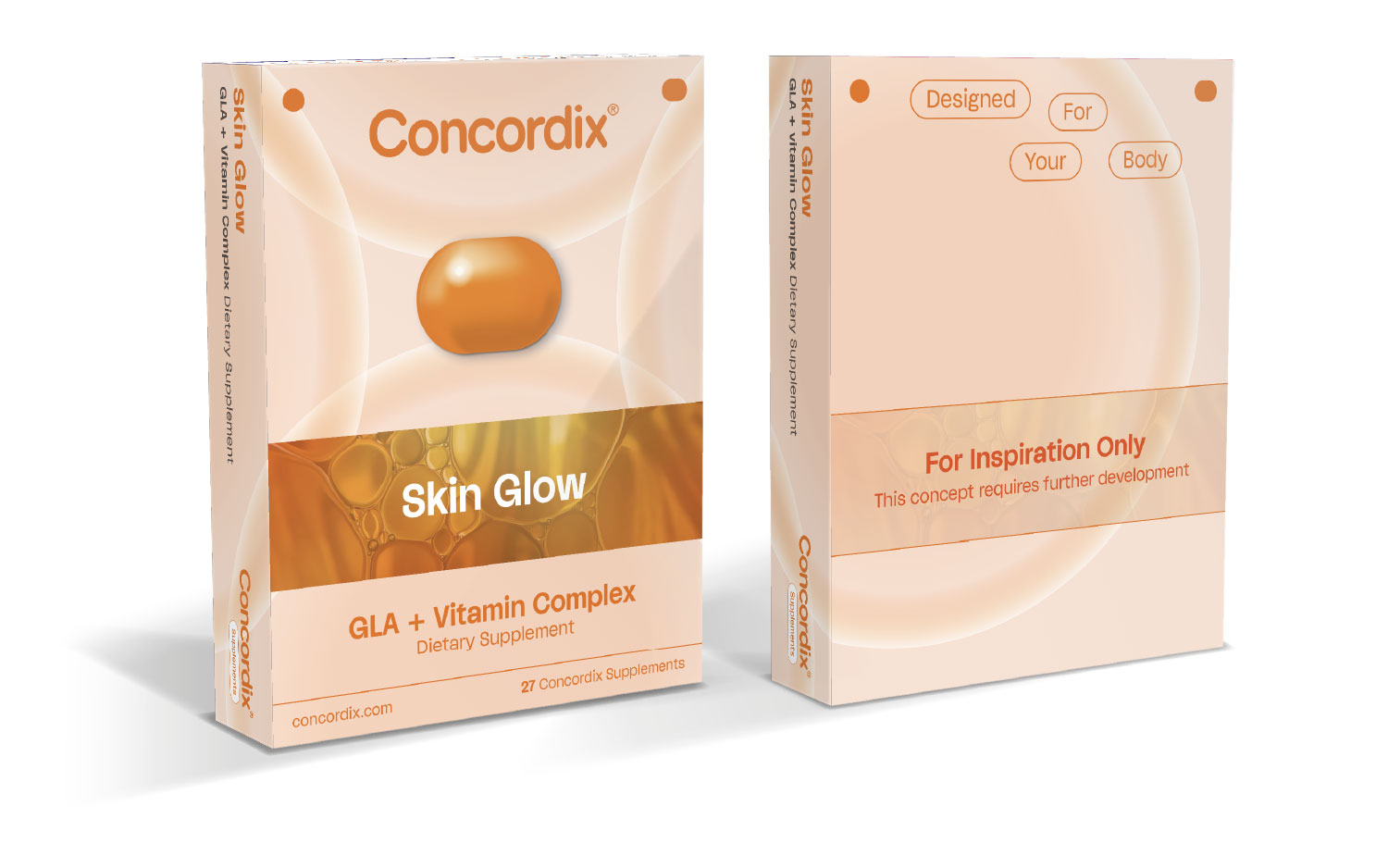
Skin Glow

GLA + Vitamin Complex
For Inspiration Only

Radiant Skin from Within

Skin Glow combines gamma-linolenic acid (GLA), vitamin A, and vitamin B3 (niacin) in a convenient daily chew designed to support skin health and maintain normal skin function from the inside out. This advanced formula was created to target key pillars of skin wellness—hydration, barrier integrity, and overall skin vitality—providing a scientifically backed foundation for a beauty supplement that promotes radiant, healthy-looking skin.

For inspiration only. This product requires further development. Color and flavor to be defined.

Supplement facts

  • Borage Oil (GLA) 100 mg
  • Vitamin A 200 mcg
  • Vitamin B3 10 mg
  • Vitamin C 15 mg
  • Vitamin E 6 mg

• Serving Size: 1 Concordix supplement
• Flavor & Color: To be defined.
• Packaging: Individually sealed in aluminum blister packs; cartons made from recycled material available

Targeted Support for Skin Health

Gamma-Linolenic Acid (GLA):
Supports the maintenance of the skin’s normal barrier function, providing a foundation for healthy skin
Contributes to overall skin wellness
Vitamin A:
Essential for normal skin cell growth and differentiation
Supports the maintenance of normal skin structure, helping skin retain its natural resilience
Vitamin B3 (Niacin):
Contributes to the maintenance of normal skin and barrier function
Supports healthy skin appearance and cellular health, laying the groundwork for a refined, healthy-looking texture
Vitamin E:
Supports protection of skin cells from oxidative stress.
• Contributes to the maintenance of normal skin.
Vitamin C:
• Contributes to normal collagen formation for healthy skin.
• Supports protection of skin cells from oxidative stress

Concordix® Chewable Emulsion Technology

Concordix® patented chewable emulsion technology delivers nutrients through a finely dispersed matrix of microscopic droplets, stabilizing sensitive ingredients and ensuring consistent quality in every dose. Skin Glow provides GLA, vitamin A, vitamin B3, vitamin C, and vitamin E in a convenient, enjoyable format to support consistent nutrient delivery and encourage daily compliance. Individually sealed blisters protect freshness, flavor, and nutrient integrity throughout the shelf life.

What Makes Concordix® Superior

• Expertly formulated for whole-body beauty and skin wellness
• Combines five essential nutrients backed by robust science
Nordic innovation designed for advanced nutrient stability and precise delivery
Pleasant chewable format designed for daily enjoyment and compliance
Individually sealed to ensure freshness and quality throughout the shelf life
Clean ingredients from natural sources and no preservatives
Sugar-free formulation

Why Consumer Brands Choose Skin Glow

Skin Glow is a science-driven formulation that helps brands differentiate in the beauty-from-within category. By combining well-known skin-supporting nutrients with advanced Concordix® delivery technology, brands can offer consumers a premium product that supports healthy-looking skin while highlighting quality, innovation, and reliability.


These statements have not been evaluated by the Food and Drug Administration. This product is not intended to diagnose, treat, cure, or prevent any disease.

Borage Oil (GLA)

Fatty acids, particularly omega-3 fatty acids, are well-known for their role in reducing inflammation in the body (1). On the other hand, omega-6 fatty acids hold a reputation for triggering low-grade inflammation, but in fact show potential for lowering “bad” LDL cholesterol and raising “good” HDL cholesterol (2). Borage oil is one of those omega-6 fatty acids that shows great promise for providing heart health benefits.

What is borage oil?

Borage oil is made up mostly of the omega-6 fatty acid known as gamma linolenic acid (GLA) (3). It’s a lesser known fatty acid with promising health benefits (3). Borage oil claims suggest that it could help reduce inflammation in the body such as helping those with arthritis, allergies, or inflammatory skin conditions like atopic dermatitis.

Isn’t omega-6 fatty acid harmful to health?

Some previous studies may have said that omega-6 fatty acids are harmful since its most common form, linolenic acid, can be converted to pro-inflammatory arachidonic acid (2). Research by experts of the American Heart Association have since found that very little linolenic acid converts to this other compound, even when someone consumes a great deal of linolenic acid.

Is there research on the benefits of borage oil?

Research shows that borage oil, because of its GLA content, is an effective agent for treatment of such conditions as (4):
• Acute respiratory distress syndrome
• Rheumatoid arthritis
• Atopic dermatitis
• Diabetic neuropathy
• Menopause-related symptoms
It can improve health of the bones as well as reduce inflammation throughout the entire body.

How much borage oil should I consume daily?

When taking borage oil by mouth for conditions like rheumatoid arthritis, a dose of 1.1 to 1.4 grams of borage seed oil daily for 24 weeks is safe and effective (5). However, be sure to talk with your healthcare provider before taking any new supplement.

Side effects and safety of borage oil

Borage seed oil is generally tolerated in most adults without adverse effects (6). It’s important though to ensure you use a trusted brand of borage oil since this oil naturally contains compounds called pyrrolizidine alkaloids (PA) that can be harmful to health (5). Therefore, choose PA-free borage oil products.
Those who are pregnant, breastfeeding, or have bleeding disorders should not consume any borage oil products (5). Also, due to increased risk of bleeding, those who are planning on having surgery in 2 weeks should avoid borage oil. Those who are taking certain medicines should talk to their pharmacist before taking borage seed oil due to potential side effects. These medicines include anesthesia, non-steroidal anti-inflammatory drugs (NSAIDs) like ibuprofen or naproxen, or blood clotting drugs.

Bottom line

Newer research shows certain omega-6 fatty acids, like borage oil, can provide heart health benefits unlike what was previously thought. Borage oil can help reduce inflammation in the body and in turn reduce symptoms of certain inflammatory conditions. Therefore, speak to your healthcare provider today to see if borage oil may help you improve your health in any way.
References

1. Saini, R.K. and Keum, Y.S. (June 2018) “Omega-3 and omega-6 polyunsaturated fatty acids: Dietary sources, metabolism, and significance- A review.” Life sciences, 203: 255-267.
2. Harvard Health Publishing Harvard Medical School (updated August 20, 2019) “No need to avoid heart-healthy omega-6 fatty acids.” https://www.health.harvard.edu…
3. University of Rochester Medical Center (accessed January 10, 2020) “Borage oil.” https://www.urmc.rochester.edu…
4. Tasset-Cuevas, I., et al. (2013) “Protective Effect of Borage Seed Oil and Gamma Linolenic Acid on DNA: In Vivo and In Vitro Studies.” PLoS One, 8(2): e56986, https://www.ncbi.nlm.nih.gov/p…
5. RxList (accessed January 12, 2020) “Borage.” https://www.rxlist.com/borage/…
6. Drugs and Lactation Database (LactMed) [Internet]. (2006-present). Bethesda (MD): National Library of Medicine (US), https://www.ncbi.nlm.nih.gov/p…
View all ingredients

Vitamin A

Vitamin A is an essential fat-soluble bioactive, also known as retinol. There are 2 forms of vitamin A available in the diet: preformed and provitamin A. Preformed vitamin A comes from animal sources, with high concentrations in fish oils, eggs and milk. Provitamin A comes from plant sources and is mainly found in the form as carotenoids with the most important one: beta-carotene. The body converts these provitamin carotenoids into vitamin A.

Both preformed vitamin A and provitamin A must be metabolized intracellularly to retinal and retinoic acid, the active forms of vitamin A, to support the vitamin’s important biological function. Vitamin A plays a key role in several bodily functions including:

Vision

Vitamin A is critical for vision as an essential component of rhodopsin, a protein that absorbs light in the retinal receptors. Vitamin A maintains vision because it continuously forms new rhodopsin. Retinoic acid, is a substitute of vitamin A and supports the conjunctival membranes and cornea.

Growth and development

Vitamin A is involved in genetic regulation of cell formation and differentiation and intercellular communication. It is critical during the (neurological) development of the foetus.

Immune system

Vitamin A also supports the immune system and helps to protect against infections and invading antigens.

Skin and mucous membranes

The skin is a mechanical immune barrier, and sufficient concentrations of vitamin A available, maintain skin health.

The European Food Safety Authority (EFSA) has acknowledged the following beneficial effects of preformed vitamin A and provitamin A as a basis for health claims:
• Normal cell differentiation
• Normal function of the immune system
• Maintenance of normal skin and mucous membranes
• Maintenance of normal vision
• Normal metabolism of iron

View all ingredients

Vitamin B3

Vitamin B is a group of bioactives that are water-soluble:
• Thiamine – B1
• Riboflavin – B2
• Niacin – B3
• Pantothenic acid – B5
• Pyridoxine – B6
• Biotin – B7
• Folate – B9
• Cobalamin – B12

Since most B-vitamins are combined in the same food sources (grains, meat and fish), they easily interact and support each other’s function. These vitamins mainly function as co-enzymes in a variety of metabolic and biochemical reactions. B vitamins are essential for:
• Maintaining the energy metabolism
• Cardiac function
• Proper growth and development
• Maintenance of cells and organs

Niacin – B3

Niacin plays a role in reducing cholesterol blood levels. The mechanism behind this is that niacin increases the ‘good’ cholesterol, e.g. high density lipoproteins (HDL), that helps to remove the ‘bad’ low density lipoproteins (LDL) from the blood. EFSA has acknowledged the following beneficial effects as a basis for health claims:
• Niacin – Vitamin B3 contributes to normal energy-yielding metabolism
• Niacin – Vitamin B3 contributes to the maintenance of normal skin and mucous membranes
• Niacin – Vitamin B3 contributes to the normal function of the nervous system
• Niacin – Vitamin B3 contributes to normal psychological functions

View all ingredients

Vitamin C

Vitamin C is a water-soluble vitamin that is naturally present various foods but mainly in vegetables and fruit. Highest concentrations of vitamin C are found in red and yellow peppers. For good health it should be available in the diet daily. Recommended daily amounts for vitamin C are 110 mg for men and 80 mg for women, while children should take at least 20 mg per day. Because the body can’t store large amounts, there is a threshold for vitamin C; the body can’t absorb more than 50 mol/L and the surplus is excreted via the kidneys in urine.

Vitamin C plays a key role in several bodily functions including:

Antioxidant – Protection

Vitamin C is well known for its antioxidant properties; it cooperates well with vitamin E and prevents alone and in combination with vitamin E against oxidative damage from free radicals. By limiting oxidative damage, vitamin C helps to reduce the risk for chronic diseases including hearth diseases. Some research has suggested that vitamin C may help treat cancer by fighting oxidative damage.

Normal structure of tissues

Sufficient daily intake of vitamin C improves repair of tissues such as bones, teeth, skin and blood vessels. This is because vitamin C contributes to the production of collagen which is primary for tissue repair.

Nervous system

Vitamin C supports the normal function of the nervous system. Its primary role is to support the production (biosynthesis) of noradrenaline. In addition, vitamin C is involved in the modulation of neurotransmitter receptors that are needed for normal psychological functions.

Immune system

Vitamin C plays an important role in the normal function of the immune system. It supports the immune defence primarily through scavenging free radicals. Free radicals are produced when immune cells attack invading bacteria and viruses. Large amounts of free radicals are also produced during extreme physical exercise and jeopardizes the immune system. Because vitamin C is such a strong antioxidant, it counteracts the harm of free radicals.

Blood iron levels

Vitamin C supports healthy iron levels. It prevents anaemia by improving the absorption of iron from plant-based foods.

Energy levels

Vitamin C is important for sufficient energy levels and reduces tiredness and fatigue. It is important for the production of energy formation in cells.

EFSA has acknowledged the following beneficial effects as a basis for health claims:

  • Vitamin C contributes to the protection of cell constituents from oxidative damage
  • Vitamin C contributes to normal collagen formation and the normal function of bones, teeth, cartilage, gums, skin and blood vessels
  • Vitamin C contributes to the normal function of the nervous system
  • Vitamin C increases non-haem iron absorption
  • Vitamin C contributes to a normal function of the immune system
  • Vitamin C contributes to maintain the normal function of the immune system during and after intense physical exercise
  • Vitamin C contributes to normal energy-yielding metabolism
  • Vitamin C can contribute to the reduction of tiredness and fatigue
  • Vitamin C contributes to normal psychological functions
  • Vitamin C contributes to the regeneration of the reduced form of vitamin E
View all ingredients

Vitamin E

Vitamin E is a generic term covering all tocopherols and tocotrienols which qualitatively exhibit the same biological activity as α−tocopherol. Therefore, vitamin E refers to α-, β-, γ- and δ-tocopherols, plus α-, β-, γ- and δ-tocotrienols.

Antioxidant

Vitamin E is long recognised as the body´s major lipid soluble antioxidant, and thus is fundamental in maintaining the integrity and functionality of the cellular membranes of all cells of the human body. As an antioxidant, vitamin E acts within cell membranes, constructed from unsaturated fatty acids and protects the cell membranes from oxidation. In doing so, the vitamin is oxidised itself and must be ‘recycled’ back to its active form, typically by vitamin C.

Due to its role as an antioxidant, vitamin E may play a key role in the protection against conditions associated with increased oxidative stress, such as cardiovascular disease, diabetes, disorders involving chronic inflammation, cancer, and neurologic disorders.

Other effects

In addition to its antioxidant function, research demonstrated specific roles of vitamin E in signal transduction, gene expression, and regulation of cellular functions, including immune response. There is substantial evidence that vitamin E has a role in the prevention of atherosclerosis by inhibiting low density lipoprotein (LDL) oxidation and anti-inflammatory actions.
EFSA has acknowledged the following beneficial effects as a basis for health claim:
• Vitamin E contributes to the protection of cell constituents from oxidative damage

View all ingredients

Other products in this range