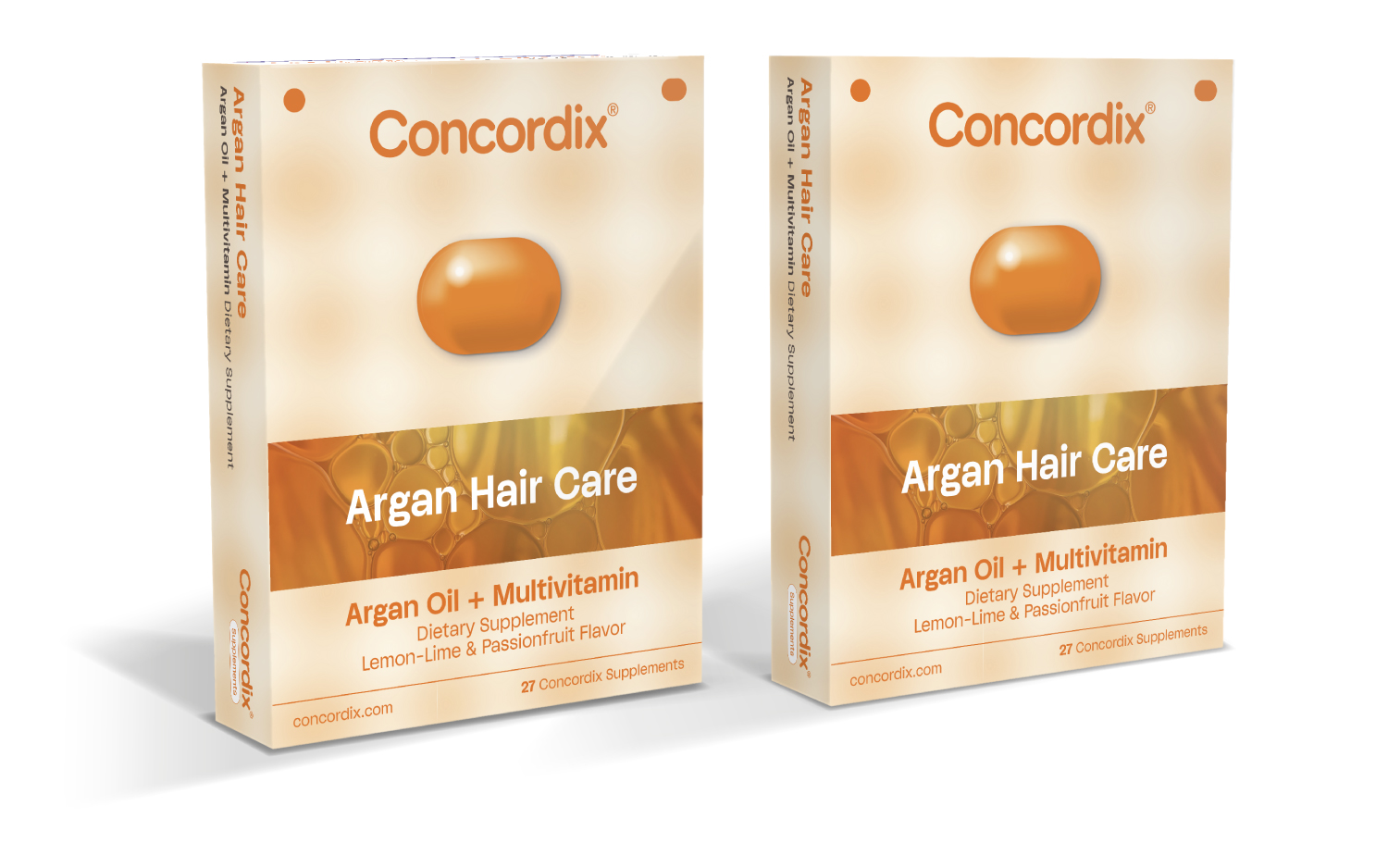
Argan Hair Care

Argan Oil + Vitamin Complex
Lemon-Lime & Passionfruit Flavor

Hair Health Backed by Nutrient Synergy

Argan Hair Care delivers a comprehensive blend of hair-supporting nutrients in a convenient daily chew. With 100 mg of argan oil and essential vitamins and minerals—including selenium, biotin, zinc, and antioxidant vitamins—this formulation is designed to support hair maintenance, keratin structure, and overall hair wellness from within.

Supplement facts

  • Argan Oil 100 mg
  • Selenium 60 mcg
  • Vitamin A 400 mcg-RE
  • Vitamin B3 8 mg
  • Vitamin B7 500 mcg
  • Vitamin C 15 mg
  • Vitamin E 9 mg-a-TE
  • Zinc 2,5 mg

• Serving Size: 1 Concordix supplement
• Flavor: Lemon-Lime & Passionfruit (Other flavors available)
• Color: Orange
• Packaging:
Individually sealed in aluminum blister packs; cartons made from recycled material available

Targeted Support for Hair Health

Argan Oil: Provides essential fatty acids that help support hair’s natural smoothness and structure.
Selenium: Contributes to the maintenance of normal hair.
Vitamin A: Supports the maintenance of normal skin, including the scalp environment that supports hair.
Vitamin B3 (Niacin): Supports normal energy-yielding metabolism important for healthy hair follicles.
Biotin (Vitamin B7): Contributes to the maintenance of normal hair by supporting keratin infrastructure.
Vitamin C: Contributes to normal collagen formation and helps protect cells from oxidative stress.
Vitamin E: Helps protect cells from oxidative stress.
Zinc: Contributes to the maintenance of normal hair and supports normal protein synthesis.

Concordix® Chewable Emulsion Technology

Concordix® patented chewable emulsion technology combines oil- and water-soluble ingredients in a finely dispersed matrix designed for stable, consistent nutrient delivery. This design helps protect sensitive nutrients and maintains uniform nutrient distribution in every chew. Individually sealed blisters further protect each dose from moisture, oxygen, and light to ensure optimal freshness and nutrient integrity.

What Makes Concordix® Superior

• Expertly formulated with a complete blend of hair wellness nutrients
Combines oil- and water-soluble ingredients in a stable emulsion format
Nordic innovation designed for nutrient stability and consistent delivery
Pleasant chewable texture and flavor designed for daily enjoyment and compliance
Individually sealed blisters ensure freshness, potency, and quality throughout the shelf life
Clean-label ingredients with colors and flavors from natural sources and no preservatives
Sugar-free formulation

Why Consumer Brands Choose Argan Hair Care

Argan Hair Care is a launch-ready, science-driven formulation that helps brands stand out in the beauty-from-within category. By combining well-known hair-supporting nutrients with advanced Concordix® delivery technology, brands can offer consumers a premium product that supports normal hair health while emphasizing quality, innovation, and reliability.


These statements have not been evaluated by the Food and Drug Administration. This product is not intended to diagnose, treat, cure, or prevent any disease.


Argan Oil

There are many unsaturated fatty acids that can provide health benefits. However, those in argan oil hold potential for improving health in many ways. Read below to learn more about this unique oil and how it can enhance your health today.

What is argan oil?

Also known as Argania spinosa, argan oil is a compound made of 80-percent mono-unsaturated fatty acids as well as sterols and antioxidant compounds like carotenoids (1,2). Virgin argan oil is harvested from the fruit of the argan tree and is obtained from a cold-pressing method (3). The fruit from which the oil is harvested is naturally found in Morocco.

This type of oil contains compounds like linoleic and oleic acids, antioxidant tocopherols (vitamin E), vitamin A, and melatonin (3). These properties make this oil a potent agent in fighting inflammation in the body and reducing related chronic disease risk.

Is there research on the benefits of argan oil?

Research shows that argan oil is effective in many ways. One animal study shows that it can reduce blood pressure, lower risk of high blood sugar, as well as improve insulin resistance (1,3). This study shows potential for such benefits in humans upon further research.
A 2018 study review also shows that applying topical argan oil daily can improve skin health. This review reports that such argan oil usage can improve skin elasticity and hydration (2). It does this by restoring barrier function and helping to maintain water-holding capacity.
Argan oil can provide health benefits through oral intake or by applying topically to skin (4). This oil is traditionally used in cooking or spreading on toast. However, it’s also found in many health and beauty products.

How much argan oil should I consume daily?

Studies show that safe and effective doses of argan oil include 25-30 milliliters daily for 3 to 4 weeks (4). This dosage helped improve cholesterol levels and antioxidant activity in healthy subjects.

Side effects and safety of argan oil

Those with allergic hypersensitivity may experience side effects like pneumonitis, or inflammation of the lungs if they use argan oil (4). Also, because of lack of research on side effects in pregnant and breastfeeding women, these women should avoid using argan oil.

Bottom line

Argan oil is a unique mono-unsaturated compound that holds antioxidant potential for improving skin, heart, and metabolic health. However, it’s important to be safe and talk to your healthcare provider before starting any new supplement regimen.

References

1. Lizard, G., Filali-Zegzouti, and Midaoui, A.E. (July 2017) “Benefits of Argan Oil on Human Health- May 4-6 2017, Errachidia, Morocco.” International Journal of Molecular Sciences, 18(7): 1383.
2. Lin, T-K., Zhong, L., and Santiago, J.L. (January 2018) “Anti-Inflammatory and Skin Barrier Repair Effects of Topical Application of Some Plant Oils.” 19(1): 70.
3. Midaoui, A.E., et al. (November 2017) “Argan Oil as an Effective Nutri-Therapeutic Agent in Metabolic Syndrome: A Preclinical Study.” International Journal of Molecular Sciences, 18(11): 2492.
4. Drugs.com (last updated December 2, 2019) “Argan.” https://www.drugs.com/npp/arga…
View all ingredients

Selenium

Selenium is a trace element that is naturally present in many foods. Selenium, which is nutritionally essential for humans, is a constituent of more than two dozen selenoproteins that play critical roles in reproduction, thyroid hormone metabolism, DNA synthesis, and protection from oxidative damage and infection.
Selenium exists in two forms: inorganic (selenate and selenite) and organic (selenomethionine and selenocysteine). Both forms can be good dietary sources of selenium.

Most selenium that is present in human tissues is in the form of selenomethionine where it can be incorporated non-specifically with the amino acid methionine in body proteins. Skeletal muscle is the major site of selenium storage, accounting for approximately 28% to 46% of the total selenium pool.

Effects

Because of seleniums’ effects on DNA repair, apoptosis, and the endocrine and immune systems as well as other mechanisms, including its antioxidant properties, selenium might play a role in the prevention of cancer. Selenium also supports the immune system by scavenging oxidative products that are produced during an immune response when invading viruses are attacked.

In addition, selenoproteins help prevent the oxidative modification of lipids, reducing inflammation and preventing platelets from aggregating. As a consequence, selenium could reduce the risk for cardiovascular diseases. Some studies have suggested that selenium may prevent the cognitive decline in elderly.

The European Food Safety Authority (EFSA) has acknowledged the following beneficial effects as a basis for health claims:
• Selenium contributes to normal thyroid function
• Selenium contributes to normal function of the immune system
• Selenium contributes to the protection of DNA, proteins and lipids from oxidative damage
• Selenium contributes to the maintenance of normal nails
• Selenium contributes to the maintenance of normal hair
• Selenium contributes to normal spermatogenesis

View all ingredients

Vitamin A

Vitamin A is an essential fat-soluble bioactive, also known as retinol. There are 2 forms of vitamin A available in the diet: preformed and provitamin A. Preformed vitamin A comes from animal sources, with high concentrations in fish oils, eggs and milk. Provitamin A comes from plant sources and is mainly found in the form as carotenoids with the most important one: beta-carotene. The body converts these provitamin carotenoids into vitamin A.

Both preformed vitamin A and provitamin A must be metabolized intracellularly to retinal and retinoic acid, the active forms of vitamin A, to support the vitamin’s important biological function. Vitamin A plays a key role in several bodily functions including:

Vision

Vitamin A is critical for vision as an essential component of rhodopsin, a protein that absorbs light in the retinal receptors. Vitamin A maintains vision because it continuously forms new rhodopsin. Retinoic acid, is a substitute of vitamin A and supports the conjunctival membranes and cornea.

Growth and development

Vitamin A is involved in genetic regulation of cell formation and differentiation and intercellular communication. It is critical during the (neurological) development of the foetus.

Immune system

Vitamin A also supports the immune system and helps to protect against infections and invading antigens.

Skin and mucous membranes

The skin is a mechanical immune barrier, and sufficient concentrations of vitamin A available, maintain skin health.

The European Food Safety Authority (EFSA) has acknowledged the following beneficial effects of preformed vitamin A and provitamin A as a basis for health claims:
• Normal cell differentiation
• Normal function of the immune system
• Maintenance of normal skin and mucous membranes
• Maintenance of normal vision
• Normal metabolism of iron

View all ingredients

Vitamin B3

Vitamin B is a group of bioactives that are water-soluble:
• Thiamine – B1
• Riboflavin – B2
• Niacin – B3
• Pantothenic acid – B5
• Pyridoxine – B6
• Biotin – B7
• Folate – B9
• Cobalamin – B12

Since most B-vitamins are combined in the same food sources (grains, meat and fish), they easily interact and support each other’s function. These vitamins mainly function as co-enzymes in a variety of metabolic and biochemical reactions. B vitamins are essential for:
• Maintaining the energy metabolism
• Cardiac function
• Proper growth and development
• Maintenance of cells and organs

Niacin – B3

Niacin plays a role in reducing cholesterol blood levels. The mechanism behind this is that niacin increases the ‘good’ cholesterol, e.g. high density lipoproteins (HDL), that helps to remove the ‘bad’ low density lipoproteins (LDL) from the blood. EFSA has acknowledged the following beneficial effects as a basis for health claims:
• Niacin – Vitamin B3 contributes to normal energy-yielding metabolism
• Niacin – Vitamin B3 contributes to the maintenance of normal skin and mucous membranes
• Niacin – Vitamin B3 contributes to the normal function of the nervous system
• Niacin – Vitamin B3 contributes to normal psychological functions

View all ingredients

Vitamin B7

Vitamin B is a group of bioactives that are water-soluble:

• Thiamine – B1
• Riboflavin – B2
• Niacin – B3
• Pantothenic acid – B5
• Pyridoxine – B6
• Biotin – B7
• Folate – B9
• Cobalamin – B12

Since most B-vitamins are combined in the same food sources (grains, meat and fish), they easily interact and support each other’s function. These vitamins mainly function as co-enzymes in a variety of metabolic and biochemical reactions. B vitamins are essential for:
• Maintaining the energy metabolism
• Cardiac function
• Proper growth and development
• Maintenance of cells and organs

Biotin – B7

Biotin has an important role in the enzymatic breakdown of macronutrients (fats, carbohydrates, and proteins) which is important for the energy metabolism. This vitamin B7 improves the synthesis of keratin and therefore it is important for the normal growth of hair and the health of the skin and nails.

EFSA has acknowledged the following beneficial effects as a basis for health claims:
• Biotin – B7 contributes to macronutrient metabolism
• Biotin – B7 contributes to normal energy-yielding metabolism
• Biotin – B7 contributes to normal psychological functions
• Biotin – B7 contributes to maintenance of normal skin and mucous membranes
• Biotin – B7 contributes to normal function of the nervous system

View all ingredients

Vitamin C

Vitamin C is a water-soluble vitamin that is naturally present various foods but mainly in vegetables and fruit. Highest concentrations of vitamin C are found in red and yellow peppers. For good health it should be available in the diet daily. Recommended daily amounts for vitamin C are 110 mg for men and 80 mg for women, while children should take at least 20 mg per day. Because the body can’t store large amounts, there is a threshold for vitamin C; the body can’t absorb more than 50 mol/L and the surplus is excreted via the kidneys in urine.

Vitamin C plays a key role in several bodily functions including:

Antioxidant – Protection

Vitamin C is well known for its antioxidant properties; it cooperates well with vitamin E and prevents alone and in combination with vitamin E against oxidative damage from free radicals. By limiting oxidative damage, vitamin C helps to reduce the risk for chronic diseases including hearth diseases. Some research has suggested that vitamin C may help treat cancer by fighting oxidative damage.

Normal structure of tissues

Sufficient daily intake of vitamin C improves repair of tissues such as bones, teeth, skin and blood vessels. This is because vitamin C contributes to the production of collagen which is primary for tissue repair.

Nervous system

Vitamin C supports the normal function of the nervous system. Its primary role is to support the production (biosynthesis) of noradrenaline. In addition, vitamin C is involved in the modulation of neurotransmitter receptors that are needed for normal psychological functions.

Immune system

Vitamin C plays an important role in the normal function of the immune system. It supports the immune defence primarily through scavenging free radicals. Free radicals are produced when immune cells attack invading bacteria and viruses. Large amounts of free radicals are also produced during extreme physical exercise and jeopardizes the immune system. Because vitamin C is such a strong antioxidant, it counteracts the harm of free radicals.

Blood iron levels

Vitamin C supports healthy iron levels. It prevents anaemia by improving the absorption of iron from plant-based foods.

Energy levels

Vitamin C is important for sufficient energy levels and reduces tiredness and fatigue. It is important for the production of energy formation in cells.

EFSA has acknowledged the following beneficial effects as a basis for health claims:

  • Vitamin C contributes to the protection of cell constituents from oxidative damage
  • Vitamin C contributes to normal collagen formation and the normal function of bones, teeth, cartilage, gums, skin and blood vessels
  • Vitamin C contributes to the normal function of the nervous system
  • Vitamin C increases non-haem iron absorption
  • Vitamin C contributes to a normal function of the immune system
  • Vitamin C contributes to maintain the normal function of the immune system during and after intense physical exercise
  • Vitamin C contributes to normal energy-yielding metabolism
  • Vitamin C can contribute to the reduction of tiredness and fatigue
  • Vitamin C contributes to normal psychological functions
  • Vitamin C contributes to the regeneration of the reduced form of vitamin E
View all ingredients

Vitamin E

Vitamin E is a generic term covering all tocopherols and tocotrienols which qualitatively exhibit the same biological activity as α−tocopherol. Therefore, vitamin E refers to α-, β-, γ- and δ-tocopherols, plus α-, β-, γ- and δ-tocotrienols.

Antioxidant

Vitamin E is long recognised as the body´s major lipid soluble antioxidant, and thus is fundamental in maintaining the integrity and functionality of the cellular membranes of all cells of the human body. As an antioxidant, vitamin E acts within cell membranes, constructed from unsaturated fatty acids and protects the cell membranes from oxidation. In doing so, the vitamin is oxidised itself and must be ‘recycled’ back to its active form, typically by vitamin C.

Due to its role as an antioxidant, vitamin E may play a key role in the protection against conditions associated with increased oxidative stress, such as cardiovascular disease, diabetes, disorders involving chronic inflammation, cancer, and neurologic disorders.

Other effects

In addition to its antioxidant function, research demonstrated specific roles of vitamin E in signal transduction, gene expression, and regulation of cellular functions, including immune response. There is substantial evidence that vitamin E has a role in the prevention of atherosclerosis by inhibiting low density lipoprotein (LDL) oxidation and anti-inflammatory actions.
EFSA has acknowledged the following beneficial effects as a basis for health claim:
• Vitamin E contributes to the protection of cell constituents from oxidative damage

View all ingredients

Zinc

Zinc is an essential mineral that is naturally present in some foods. Zinc is involved in numerous aspects of the cellular metabolism. It is required for the catalytic activity of approximately 100 enzymes and it plays a role in immune function, protein synthesis, wound healing, DNA synthesis, and cell division. Zinc also supports normal growth and development during pregnancy, childhood, and adolescence and is required for proper sense of taste and smell. In addition, it also helps to normal cognitive functioning, vision and fertility. A daily intake of zinc is required to maintain a steady state because the body has no specialized zinc storage system.

Immune system

Zinc is involved in the regulation and maintenance of the normal activity of special immune cells. Some studies have demonstrated a relationship between zinc intake and reduction in the length and severity of a cold.

Wound healing

Because of its immune regulating mechanism, zinc is also critical in wound healing and the various stages of tissue reconstruction. When the skin is ruptured, the inflammatory process is activated and special immune cells are directed to the wound. There they remove bacteria from the wound. Wound healing also consists of growth of new tissue, and zinc is thought to have a beneficial role in new cell formation.

Bone health

Zinc also has a role in normal bone maintenance. Zinc is contained in crystals that form a bone matrix and is required to stimulate bone formation and inhibit bone decomposition. It is probable that zinc, in combination with calcium, might protect against the risk for osteoporosis.

Vision

Researchers have suggested that both zinc and antioxidants delay the progression of age-related macular degeneration and vision loss, possibly by preventing cellular damage in the retina.

The European Food Safety Authority (EFSA) has acknowledged the following beneficial effects as a basis for health claims:
• Zinc contributes to normal function of the immune system
• Zinc contributes to normal DNA synthesis and cell division
• Zinc contributes to the protection of cell constituents from oxidative damage
• Zinc contributes to maintenance of normal bone
• Zinc contributes to normal cognitive function
• Zinc contributes to normal fertility and reproduction
• Zinc contributes to normal metabolism of fatty acids
• Zinc contributes to normal acid-base metabolism
• Zinc contributes to normal metabolism of vitamin A
• Zinc contributes to maintenance of normal vision
• Zinc contributes to normal carbohydrate metabolism
• Zinc contributes to normal macronutrient metabolism
• Zinc contributes to normal protein synthesis
• Zinc contributes to the maintenance of normal hair
• Zinc contributes to the maintenance of normal nails
• Zinc contributes to the maintenance of normal skin
• Zinc contributes to the maintenance of normal testosterone levels in the blood
• Zinc has a role in the process of cell division

View all ingredients

Other products in this range